


A Brief History
While water power has been used for centuries, modern hydraulics rests on Pascal’s Law (17th century). In 1795, Joseph Bramah applied this principle to invent the hydraulic press, launching industrial fluid power.
The Science: Pascal’s Law
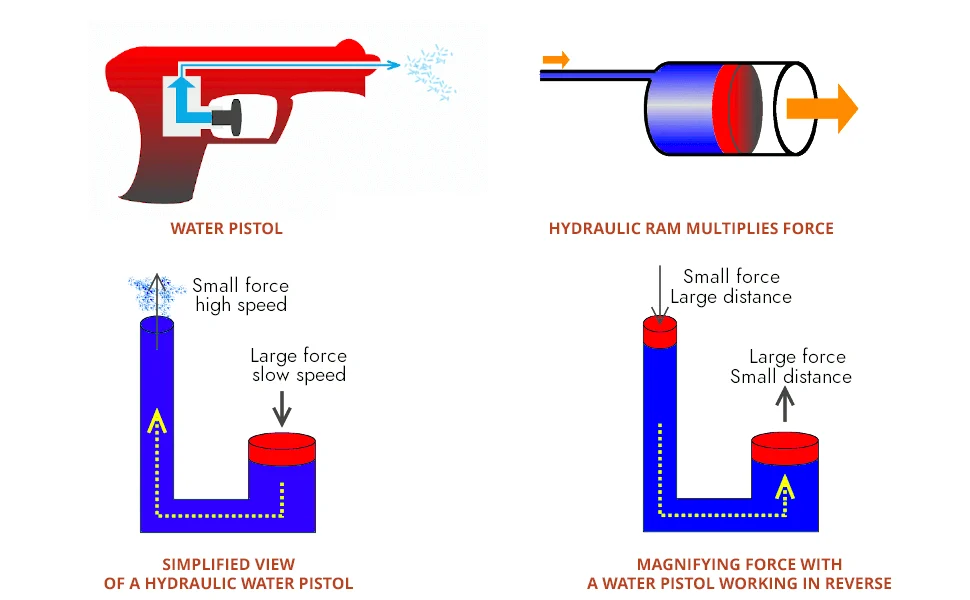
When pressure is applied to a confined fluid, it is transmitted equally and undiminished in all directions.
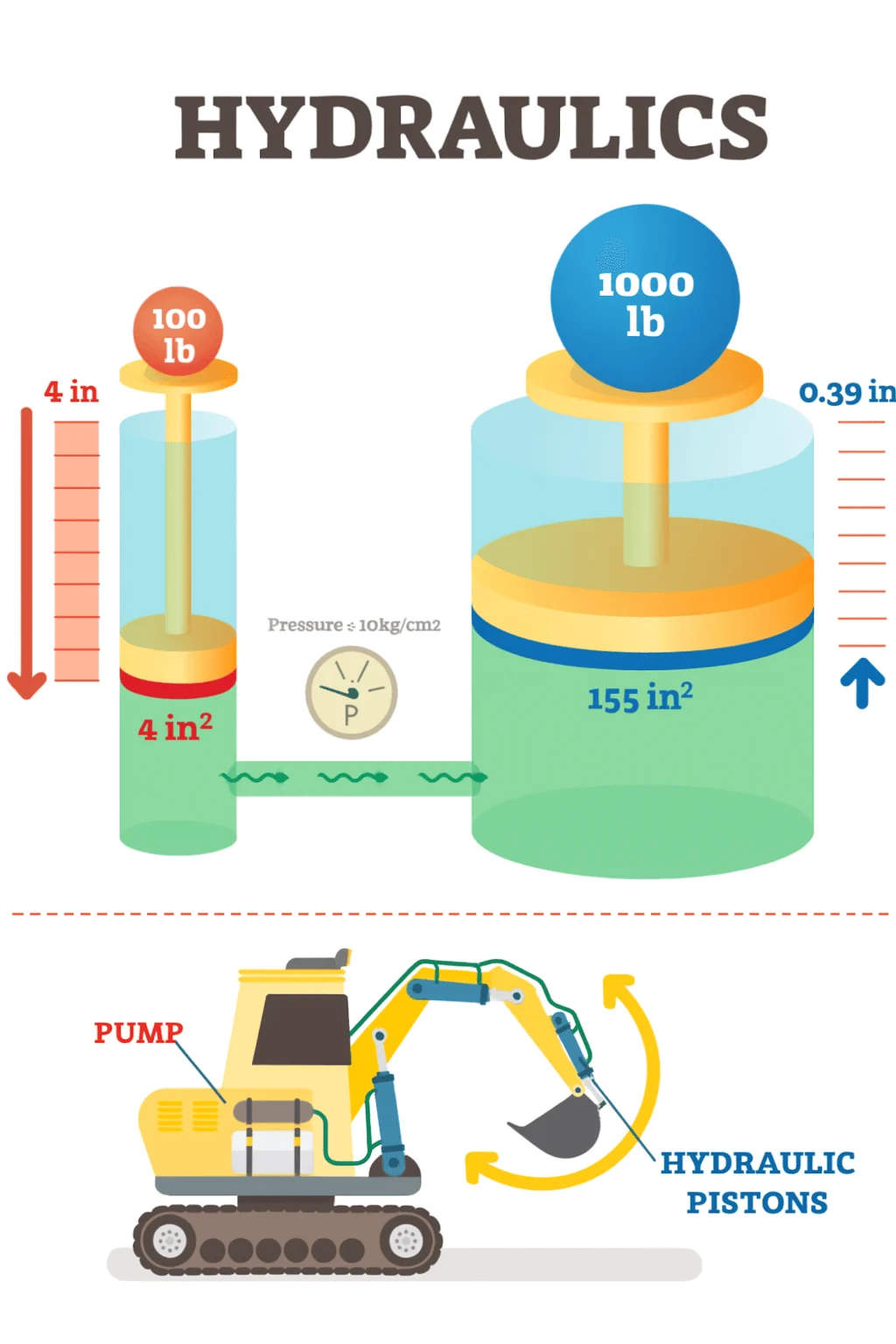
Because hydraulic fluids are nearly incompressible, a small input can produce a much larger output on a bigger piston. Mathematically:
P = F / A (pressure = force / area)
If the output piston has 10× the area of the input piston, it delivers ~10× the force at the same pressure (trading speed for force to conserve energy).

How a Hydraulic System Works
- Pressure generation: A pump draws fluid from the reservoir and pressurizes it.
- Flow control: Valves direct, regulate, and relieve pressure and flow.
- Power transmission: Pressurized fluid moves through hoses and lines in a closed loop.
- Work output: Cylinders and motors convert fluid power to linear or rotary motion.
- Return & conditioning: Fluid returns to the reservoir for cooling, deaeration, and filtration.
Key Components
| Component | Function |
|---|---|
| Reservoir | Stores fluid; enables heat dissipation and air separation. |
| Pump | Converts mechanical energy into hydraulic energy (pressure/flow). |
| Prime mover | Electric motor or engine driving the pump. |
| Valves | Control direction, flow rate, and pressure (directional, flow, pressure control). |
| Actuators | Cylinders (linear) and motors (rotary) that do the work. |
| Hoses & fittings | Carry pressurized fluid between components. |
| Filters | Remove contaminants to protect components. |
| Coolers/Heaters | Manage temperature and fluid viscosity. |
Hydraulic Circuits
A hydraulic circuit parallels an electric one: the reservoir/pump pair acts as the power source, hoses are the conductors, and actuators are the loads. All parts must form a closed loop so fluid returns to the tank for reconditioning.
Hydraulics in Heavy Equipment
Excavators, loaders, forklifts, cranes, and agricultural machines rely on hydraulics for high torque and precise motion in rugged environments. Operators manipulate small controls while hydraulics deliver large, smooth forces for lifting, digging, steering, and positioning.
Advantages
- High power density: Big force from compact components.
- Smooth, precise control: Fine speed/position control of actuators.
- Self-lubricating: Fluid reduces wear and heat.
- Flexible routing: Power transmitted through hoses over distance.
- Force multiplication: Small input → large output (with lower speed).
Limitations
- Maintenance: Fluids, seals, filters, and hoses need routine service.
- Temperature sensitivity: Fluid properties vary with heat.
- Leak risk: Requires proper fittings and cleanliness.
- Energy losses: Friction and heat reduce overall efficiency.
Maintenance Tips
- Inspect routinely for leaks; replace worn hoses and seals.
- Keep fluid clean; change and filter on schedule.
- Monitor pressure and temperature; verify relief settings.
- Service filters, coolers, and breathers regularly.
The Future: Electro-Hydraulics & AI
Modern systems integrate sensors, PLCs, and smart controls for efficiency and safety. Expect broader use of variable pumps, real-time diagnostics, and predictive maintenance — plus AI-assisted optimization for smoother, safer operation.
Conclusion
Hydraulics turn pressurized fluid into prec